About the Event
Lecture Abstract:
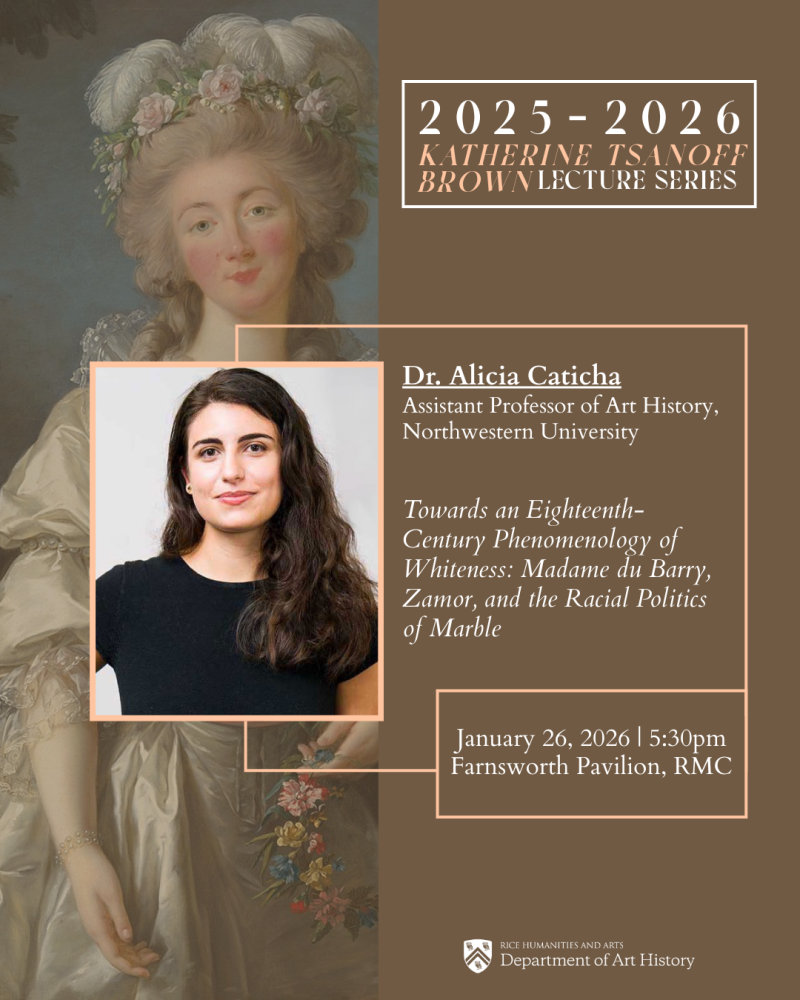
In 1769, King Louis XV of France gifted the small château of Louveciennes to his new mistress, Madame du Barry. Over the next two years, Du Barry embarked on a vast renovation project which included the construction of an entirely new pleasure pavilion, designed by the fashionable architect Claude-Nicholas Ledoux. Sculpture, and its association with a notional idea of white marble, served as the essential throughline through which both Ledoux and Du Barry wove together the new Neoclassical pavilion’s interior and exterior spaces. Deploying Sarah Ahmed’s theory of a phenomenology of whiteness, I shall illustrate how the replication of sculpture across space created an “infrastructure of whiteness” that othered non-white bodies, rendering them simultaneously invisible and hyper-visible. The biography of Louis Benoît Zamor (1762-1820), Madame du Barry’s black servant, or “blackamoor,” embodies this tension between erasure and visibility. How did Zamor experience the pavilion at Louveciennes? How did the racial politics of Neoclassical aesthetics assert and shape European notions of alterity?
The Katherine Tsanoff Brown Lecture Series is made possible through the generous support of The Katherine Brown Fund. The series honors Katherine Tsanoff Brown, a founding member of Rice University’s Department of Art History, later the Dean of Undergraduate Affairs, and an ardent supporter of public lectures and visiting scholars in the arts even after her retirement from Rice University in 1989. The inaugural lectures took place in academic year 2017-2018.
Please join us for light bites and drinks at the reception following the lecture. For catering purposes, please RSVP by January 20th.